

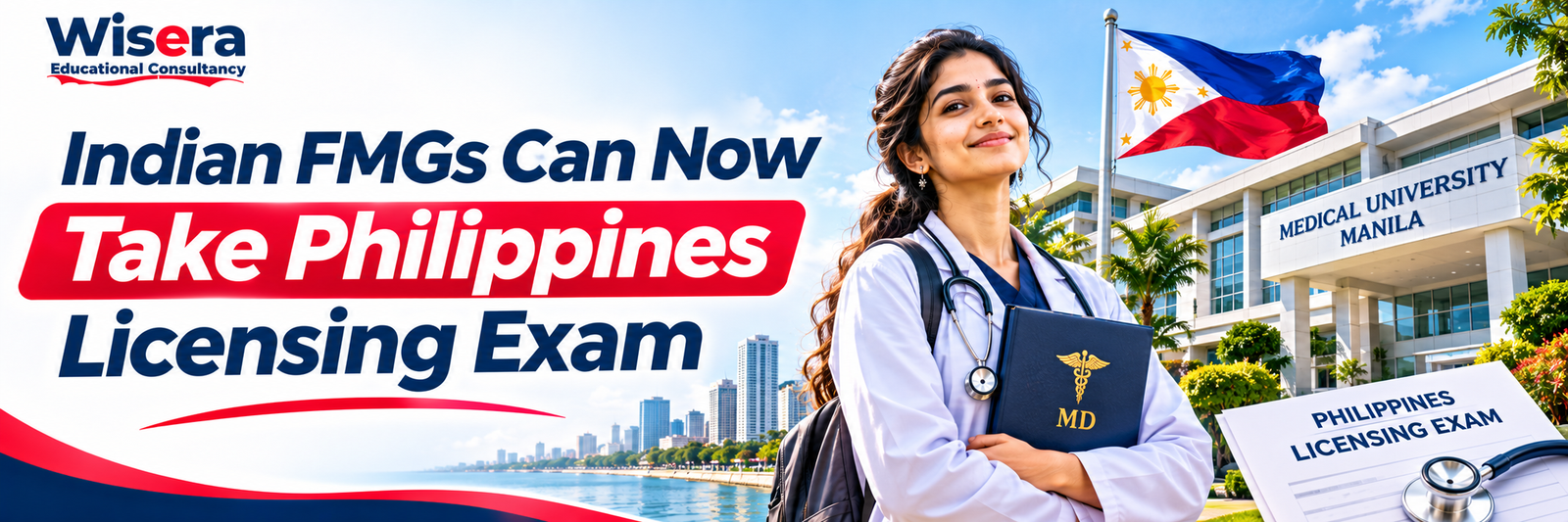
Indian FMGs Can Now Take Philippines Licensing Exam
In a landmark move for students pursuing medicine overseas, the Philippines licensing exam for Indian FMGs is now officially open to Foreign Medical Graduates (FMGs) from India. This means Indian students who studied medicine in the Philippines can now sit for the country’s Physician Licensure Examination (PLE) without first clearing the Foreign Medical Graduate Examination (FMGE) back home. The development, marks a significant policy shift that could reshape how Indian students approach MBBS education in the Philippines.
For years, Indian students studying medicine abroad have faced layered regulatory hurdles. This update simplifies one major barrier, allowing graduates to pursue licensure in the Philippines itself, rather than being restricted to clearing exams only in India before practicing anywhere else.
WISERA COUNSELLING DESK
Not sure which university matches your NEET score?
Get a free comparison call on NMC-approved options within your budget.
What Changed in the Licensing Process?
Previously, Indian medical graduates who completed their MBBS equivalent in the Philippines were required to clear the FMGE in India before being considered eligible for further licensing steps in other countries. With this new regulation, the Philippines Professional Regulation Commission (PRC) now permits Indian FMGs to directly appear for the Physician Licensure Examination, independent of their FMGE status.
This is a big deal because it:
- Removes the dependency on clearing FMGE before attempting the Philippines’ own licensing exam
- Allows Indian graduates to validate their medical qualification within the Philippines itself
- Opens up a dual pathway — students can now explore licensure both in India and the Philippines
- Strengthens the credibility of Philippines-based MBBS programs among Indian students
- Gives students more flexibility in planning their post-graduation career, whether in India, the Philippines, or elsewhere
Why This Matters for Indian MBBS Aspirants
Every year, thousands of Indian students choose the Philippines for MBBS due to its affordable fees, English-medium instruction, and curriculum aligned with international standards. However, a common concern among students and parents has been the uncertainty of practicing after graduation, especially since FMGE clearance rates in India have historically been low.
With this new provision, students now have an additional safety net. Even if their immediate plans are centered around returning to India, having the option to attempt the Philippines’ licensing exam broadens their professional horizon. It also signals growing international recognition of the quality of medical education being imparted to Indian students in Philippine universities.
Understanding the Physician Licensure Examination (PLE)
The PLE is the official licensing examination administered by the Professional Regulation Commission of the Philippines. It is a mandatory test for anyone — local or foreign — intending to practice medicine within the country. The exam evaluates clinical knowledge, diagnostic skills, and understanding of medical ethics and practice standards specific to the Philippines healthcare system.
Previously, foreign graduates from India faced additional red tape due to FMGE requirements imposed by Indian regulatory norms. The removal of this prerequisite simplifies the licensing journey considerably for Indian students studying in Philippine medical colleges.
How Should Students Prepare for This Opportunity?
While this is encouraging news, students should still approach their academic journey methodically. A few points worth noting:
- Continue focusing on strong fundamentals in clinical subjects, since the PLE still demands rigorous preparation
- Stay updated with any further guidelines issued by the Philippines PRC regarding eligibility criteria for Indian applicants
- Consult with academic counselors or institutions that specialize in MBBS abroad admissions to understand how this policy fits into long-term career planning
- Keep track of FMGE requirements in India as well, since practicing within India will still require clearing it
- Maintain documentation and transcripts properly, as these are often required for licensing exam applications abroad
This dual-track approach — being eligible for both FMGE in India and PLE in the Philippines — gives Indian medical graduates far greater flexibility than before.
What This Means for the Future of MBBS in the Philippines
This policy change could potentially increase the number of Indian students opting for MBBS in the Philippines, given the added assurance of post-graduation licensing opportunities. It may also encourage Philippine universities to further align their curriculum with international licensing standards, benefiting all foreign students, not just those from India.
As cross-border medical education continues to evolve, such regulatory harmonization is a welcome step towards making global medical careers more accessible and less bureaucratic for Indian students.
Conclusion
The decision to allow Indian FMGs to appear for the Philippines’ Physician Licensure Examination without first clearing FMGE is a progressive step that enhances career flexibility for thousands of aspiring doctors. It reflects growing international confidence in Philippine medical education and offers Indian students more pathways to build a successful medical career, whether at home or abroad.
Frequently Asked Questions
What is the Philippines licensing exam for Indian FMGs?
It refers to the Physician Licensure Examination (PLE) that Indian Foreign Medical Graduates can now take in the Philippines without needing to clear FMGE first.
Do Indian students still need to clear FMGE to practice in India?
Yes, FMGE remains mandatory for practicing medicine within India, regardless of this new Philippines licensing provision.
Who administers the PLE in the Philippines?
The Professional Regulation Commission (PRC) of the Philippines administers the Physician Licensure Examination.
Does this change affect admission requirements for MBBS in the Philippines?
No, admission requirements remain the same; this update specifically concerns post-graduation licensing eligibility.
Why is this update significant for Indian medical students?
It removes a major regulatory barrier, allowing more flexible career planning for Indian students pursuing medical degrees in the Philippines.









Comments are closed