
MBBS in Kazakhstan for Indian Students: Understanding the Medical Education System and Curriculum
Most families compare MBBS in Kazakhstan for Indian students by fees first. The curriculum deserves equal attention, because it decides what your child learns and whether the degree can lead to a license in India. This guide explains how the system works, year by year, and what to confirm in writing before admission.
In this article: the 5+1 degree structure, the year-wise curriculum, how clinical training works, and the NMC checks that matter.
How Is MBBS in Kazakhstan for Indian Students Structured?
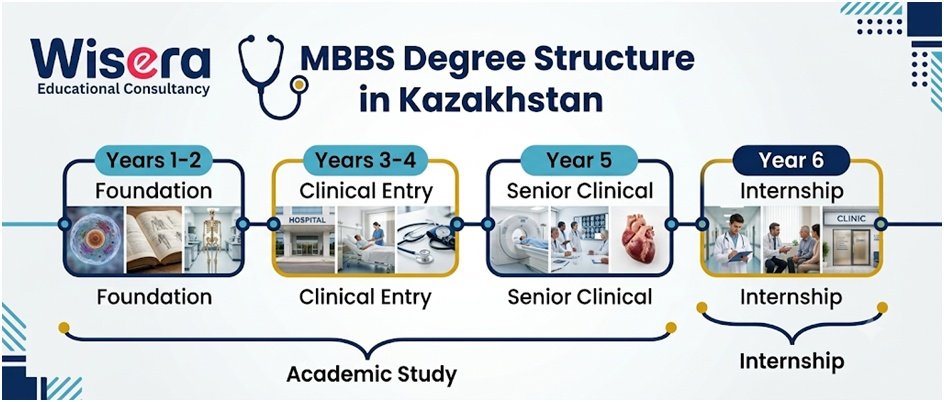
The program runs six years: five years of academic study, then a one-year internship. Kazakh universities teach it as a bachelor’s program in General Medicine, and several award the General Practitioner qualification after the internship. Universities market the qualification as MD or MBBS-equivalent, so check the exact title on your offer letter. Accreditation agencies such as IAAR and ECAQA review these programs, which gives you something concrete to verify.
Medical Degree Structure in Kazakhstan at a Glance
| Stage | Duration | Main Focus |
| Foundation | Years 1–2 (sometimes into Year 3) | Anatomy, histology, physiology, biochemistry, language classes |
| Clinical entry | Years 3–4 | Pathology, pharmacology, microbiology, internal medicine, surgery |
| Senior clinical | Year 5 | Pediatrics, obstetrics and gynecology, emergency care |
| Internship | Year 6 | Supervised practice in clinics and hospitals |
Subject placement differs by university and intake year, so treat this table as a map, not a promise.
What Does the MBBS Curriculum in Kazakhstan Cover Year by Year?
The MBBS curriculum in Kazakhstan moves from basic science to bedside practice. The first two to three years cover anatomy, histology, physiology and biochemistry, plus conversational Kazakh or Russian for patient communication. Later years turn to clinical disciplines such as internal medicine, surgery, pediatrics and obstetrics. The final year is a supervised internship in university clinics or affiliated hospitals. The Semey Medical University page on Wisera describes this same split.
Subjects to Look for in the Syllabus
● Anatomy, histology and physiology anchor the early foundation years
● Pathology, pharmacology and microbiology link basic science to disease
● Internal medicine and surgery open the clinical rotations
● Pediatrics and obstetrics dominate the senior clinical years
● Language classes prepare students for conversations with local patients
● Community medicine and forensic topics may carry different module names
Ask each university for its full subject list, then compare it with the subjects tested in India’s licensing exam.
How Does the Medical Education System in Kazakhstan Teach Clinical Skills?
Kazakh universities blend lectures, small-group practicals, simulation and hospital rotations. Many run simulation centers where students practice procedures on mannequins before treating real patients, and bedside contact grows from the third year. Some programs add problem-based learning, where small groups work through patient cases. Because most patients speak Kazakh or Russian, language preparation is part of clinical training, not an optional extra. Regular module and semester assessments track progress.
Questions to Ask About Clinical Training
● How many teaching hospitals does the university use for rotations?
● In which year does supervised bedside patient contact begin?
● Is there a simulation center, and how often is it used?
● Which clinical subjects are taught in English, and which in Russian?
● Where exactly will the one-year internship take place?
● How are promotion and semester results decided?
Compare the answers across Caspian University and Al-Farabi Kazakh National University before you decide.
WISERA COUNSELLING DESK
Not sure which university matches your NEET score?
Get a free comparison call on NMC-approved options within your budget.
Does the Kazakhstan Medical Degree Structure Meet NMC Rules?
A five-year course plus a one-year internship can fit the NMC’s Foreign Medical Graduate Licentiate (FMGL) Regulations, 2021. These ask for at least 54 months of course and a 12-month internship in the same foreign institution. The word that matters is can: each university must deliver the course in English, run the internship itself, and confirm the structure in writing. Graduates must then clear the FMGE screening test and complete a 12-month supervised internship in India.
What the Latest Updates Mean for You
- NEET qualification comes first, before joining any foreign program
- The course must run at least 54 months, taught in English
- The 12-month internship must happen at the same institution
- NMC’s August 2026 draft retains FMGE until NExT begins
- NExT has no confirmed start date, so plan around FMGE
- June 2026 FMGE pass rates fell to roughly 12–14% in published tallies
A syllabus that covers every exam subject properly matters more than ever. Read the NMC’s current notices yourself, and ask for the 54 + 12 structure on paper.
What Should You Check Before Choosing a Kazakh Medical University?
Choosing a university is where curriculum knowledge becomes a safe decision. Start with the verifiable basics: WDOMS listing, valid program accreditation, and a written statement of course length, teaching language and internship location. Treat spoken assurances, claims without documents and pressure to pay before an admission letter as warning signs. Wisera’s guide on which country is best for MBBS abroad shows how Kazakhstan compares with other destinations.
Your Pre-Admission Checklist
- Confirm the university appears in the World Directory of Medical Schools
- Request the written 5+1 structure, including the internship location
- Check that program accreditation is valid for your intake year
- Compare the subject list with NMC’s Schedule I subjects
- Confirm English teaching covers clinical years, not only lectures
- Ask for the complete cost sheet, including hostel and insurance
Wisera’s counselors can walk you through these checks in a free session. After shortlisting, follow the step-by-step MBBS abroad admission process to plan documents and timelines.
Frequently Asked Questions
Q1: How many years is MBBS in Kazakhstan?
Most programs run six years: five academic years plus a one-year internship. Confirm the exact structure with your chosen university.
Q2: Is MBBS in Kazakhstan taught in English?
Many universities offer English-medium programs for international students. Verify that clinical years are covered too, and expect basic Kazakh or Russian classes for patient communication.
Q3: Is a Kazakhstan MBBS degree valid in India?
It can be, if you meet NMC FMGL rules: NEET qualification, a 54-month course, a 12-month same-institution internship, FMGE, and a 12-month internship in India.
Q4: Is NEET required for MBBS in Kazakhstan?
Yes, for Indian students who want to practice in India. Qualify NEET before taking admission.
Q5: Does Wisera help with university selection for MBBS in Kazakhstan?
Yes. Wisera offers free counseling, university selection, admission support, visa assistance, pre-departure guidance and post-arrival support.
Your Next Step Toward MBBS in Kazakhstan
Understanding the curriculum turns a fee comparison into a real decision. The 5+1 structure, the climb from basic science to hospital practice, and the NMC’s 54 + 12 rule give you a clear checklist. Match every shortlisted university against it, in writing. Schedule a free counseling session with Wisera to get a university-by-university view of MBBS in Kazakhstan, built around your NEET score and budget.
Comments are closed