Top Medical Universities in Russia: How to Choose the Right University for MBBS
Choosing among the top medical universities in Russia can feel overwhelming once you start comparing course structures, fees, and recognition rules side by side. Every consultancy website seems to have its own shortlist, and not all of them explain what actually matters for an Indian student’s long-term career. This guide walks through what to actually check before shortlisting a Russian medical university – from recognition requirements to what happens after you graduate and come back to practise in India.
What Makes a Medical University in Russia Worth Considering?
A Russian medical university is worth shortlisting when its program duration, curriculum, and clinical training align with the requirements Indian graduates must eventually meet to practise back home – not simply because it appears on a consultancy’s list.
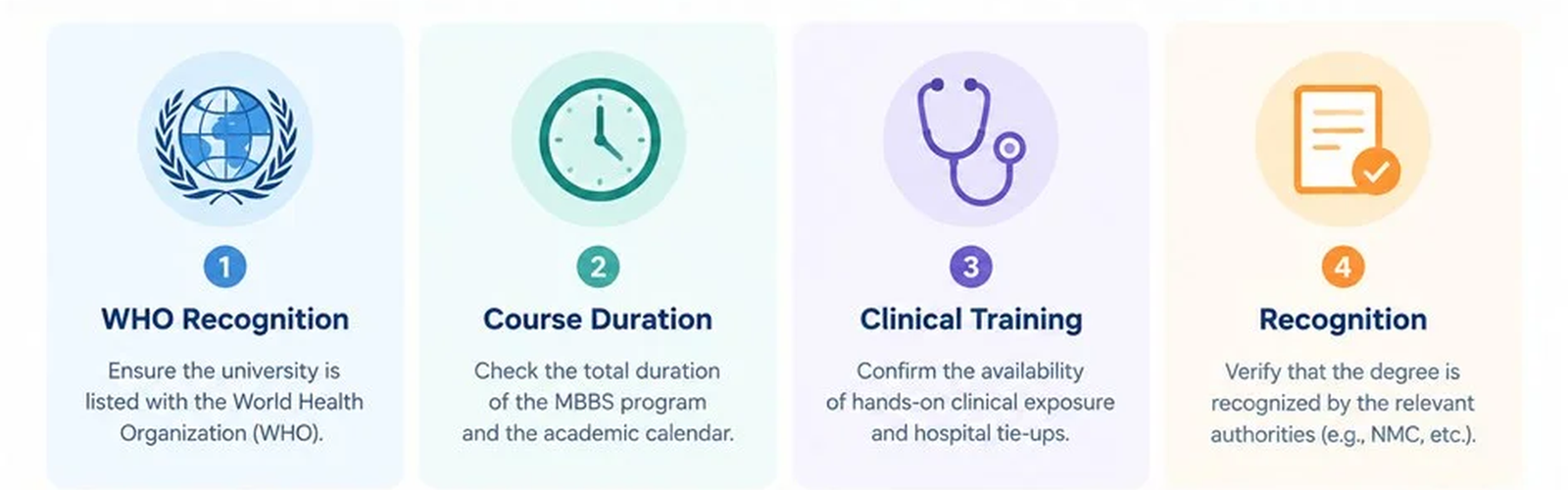
The essentials to check are: whether the university is listed in the WHO’s World Directory of Medical Schools (WDOMS), whether the program runs at least the equivalent of India’s MBBS duration including a full internship, whether teaching is genuinely delivered in English, and whether the university has an established, verifiable clinical training network.
Fees and hostel comfort matter too, but they shouldn’t come before recognition and curriculum fit. A cheaper program that falls short on any of these fronts can cost far more in delays later.
WISERA COUNSELLING DESK
Not sure which university matches your NEET score?
Get a free comparison call on NMC-approved options within your budget.
Are Russian Medical Universities Recognised by India’s NMC?
There isn’t a simple, unchanging “approved list” anymore. Since the Foreign Medical Graduates Licentiate Regulations, 2021, the National Medical Commission (NMC) evaluates eligibility based on specific criteria – course duration, internship structure, clinical exposure, and WDOMS listing – rather than issuing a single static list of approved universities.
In practice, this means a Russian university’s program needs to match India’s minimum standards: a course duration broadly equivalent to India’s MBBS, hands-on clinical training rather than compressed or largely online instruction, and a full internship completed at a genuine teaching hospital. Universities that consistently meet these standards are generally considered NMC-compliant, but the specific requirements are updated from time to time.
Because these rules can change, always verify a university’s current eligibility status directly on the NMC’s official website before taking any admission decision, rather than relying solely on a consultancy’s claim.
Duration, Curriculum, and Language of Instruction
Most Russian medical universities run a General Medicine program lasting around six years, structured as roughly five years of academic study followed by a supervised internship year, taught mainly in English with an integrated Russian-language component for clinical communication with patients.
This structure exists specifically to match the duration and clinical exposure that NMC’s current regulations expect, so any Russian program significantly shorter than this should be checked very carefully before you apply, since compressed timelines have come under specific regulatory scrutiny in recent years.
The Russian-language component isn’t optional in most programs – you’ll need enough conversational Russian to interact with patients during clinical years, even though instruction itself stays in English.
What Should You Compare Across Top MBBS Universities in Russia?
Beyond recognition and duration, a handful of practical factors separate a genuinely strong choice from a merely convenient one:
WDOMS listing status, verified directly on the WHO’s directory rather than a consultancy’s word
Whether the university runs its own affiliated teaching hospitals, not just partnership agreements
The size and consistency of its international student community over multiple years
Hostel security, city safety, and the presence of an Indian student support system
Total cost, including tuition, hostel, food, and visa costs – not just the advertised tuition figure
Whether previous graduates’ outcomes in India’s licensing exam are discussed transparently
No single university scores highest on every factor, so the “top” choice really depends on which of these matters most for your situation and budget.
A Look at a Few Established Medical Universities in Russia
Kazan State Medical University is one of Russia’s older dedicated medical institutions, tracing its roots to 1814, and hosts over 1,800 international students from more than 57 countries alongside its General Medicine program for foreign students.
Kazan Federal University, based in the same city, offers medical education through its Institute of Fundamental Medicine and Biology as part of a broader multidisciplinary university rather than a standalone medical institute – a structural difference worth understanding before you compare the two.
Bashkir State Medical University in Ufa and Volgograd State Medical University are also long-established state medical universities that regularly host international students, each with its own fee structure, hostel setup, and clinical training network worth reviewing individually.
The full list of Russian universities Wisera works with is available on the MBBS in Russia page, where each university’s specific program details are broken down separately.
Safety, Cost of Living, and Student Support
Despite the ongoing Russia-Ukraine conflict, most Indian students in Russia study in cities located far from the conflict zone, and India-Russia relations have stayed steady through this period, with Indian students continuing to enrol every year.
That said, safety shouldn’t be treated as a blanket “yes” for every city or hostel. It genuinely depends on the specific university’s hostel security, the city’s general safety record, and how well-organised the university’s support system is for international students – so this is worth asking about directly rather than assuming it’s identical everywhere.
Cost of living varies significantly by city. Smaller regional cities tend to be considerably cheaper than Moscow or St. Petersburg, but they may also have a smaller Indian student community, which matters for day-to-day comfort and support during your first year.
What Happens After You Graduate: FMGE, NExT, and Licensing in India
Passing your MBBS-equivalent degree in Russia is not the final step – Indian graduates must clear India’s licensing screening exam before they can practise here, and this exam has become notably harder to clear in recent years.
FMGE (the Foreign Medical Graduate Examination), conducted by the National Board of Examinations, has had a pass rate ranging roughly between 10% and 30% over the past several exam sessions, and the June 2026 session recorded an overall pass rate of just over 12%, though first-time candidates cleared it at a considerably higher rate of around 35%. The National Medical Commission has proposed replacing FMGE with a unified National Exit Test (NExT) for all medical graduates, but as of now, FMGE remains the operative exam – check the National Board of Examinations’ official site for the current, confirmed exam and eligibility details before assuming any transition timeline.
Given these numbers, choosing a university that takes India-specific exam preparation seriously – through bridge courses, mock tests, or structured FMGE-aligned coaching – matters just as much as the university’s campus or fees.
How to Choose the Right University for Your MBBS in Russia
Bringing all of this together, a practical shortlisting approach looks like this:
Confirm the university’s WDOMS listing and current NMC compliance status directly, not through a single secondhand source
Check that the program duration and internship structure match India’s current requirements
Ask specifically about the hostel, campus security, and Indian student support available in that city
Get a full cost breakdown – tuition, hostel, food, visa, and travel – not just the headline tuition figure
Ask whether the university or its partner consultancy offers structured FMGE preparation support
Speak with current students or recent graduates from that specific university if possible, not only the consultancy’s own testimonials
A university that checks most of these boxes for your specific budget and comfort level is a stronger choice than whichever one happens to top a generic ranking list.
Make an Informed Choice, Not a Rushed One
There’s no single “best” medical university in Russia for every student – the right one depends on your budget, your comfort with a smaller or larger Indian community, and how seriously the university takes India-specific licensing preparation. Verify recognition and duration details directly with official sources before committing to any university.
If you’d like help comparing specific Russian universities against your NEET score, budget, and preferences, Wisera’s MBBS in Russia page lists university-specific details, and our counsellors can walk you through a shortlist over a free counselling session.
Frequently Asked Questions
Which Russian medical universities are recognised by India’s NMC?
There’s no fixed public list. Recognition depends on whether a university’s program duration, curriculum, and internship structure meet the NMC’s current Foreign Medical Graduates Licentiate Regulations – always verify this directly on the NMC’s official website for your specific university.
How many years does MBBS take in Russia?
Most programs run around six years total: roughly five years of academic study followed by a one-year supervised internship, taught in English with an integrated Russian-language component.
Is Russia safe for Indian MBBS students in 2026?
Most Indian students study in cities away from the conflict zone, and enrolment has continued steadily. That said, safety depends on the specific city and hostel, so ask about security and support systems for each university individually.
Do I need to clear an exam after returning from Russia?
Yes. Indian graduates must clear India’s licensing screening exam (currently FMGE, with a National Exit Test proposed as a future replacement) before practising in India. Recent pass rates have ranged between roughly 10% and 35%, so exam preparation matters as much as your degree.
What is the approximate cost of MBBS in Russia?
Costs vary widely by university and city, generally lower in regional cities than in Moscow or St. Petersburg. Always request a full, itemised cost breakdown from the specific university rather than relying on a single average figure.
Is English medium available for MBBS in Russia?
Yes, most universities teach the General Medicine program in English, with a Russian-language component included for clinical patient interaction during later years.
Comments are closed