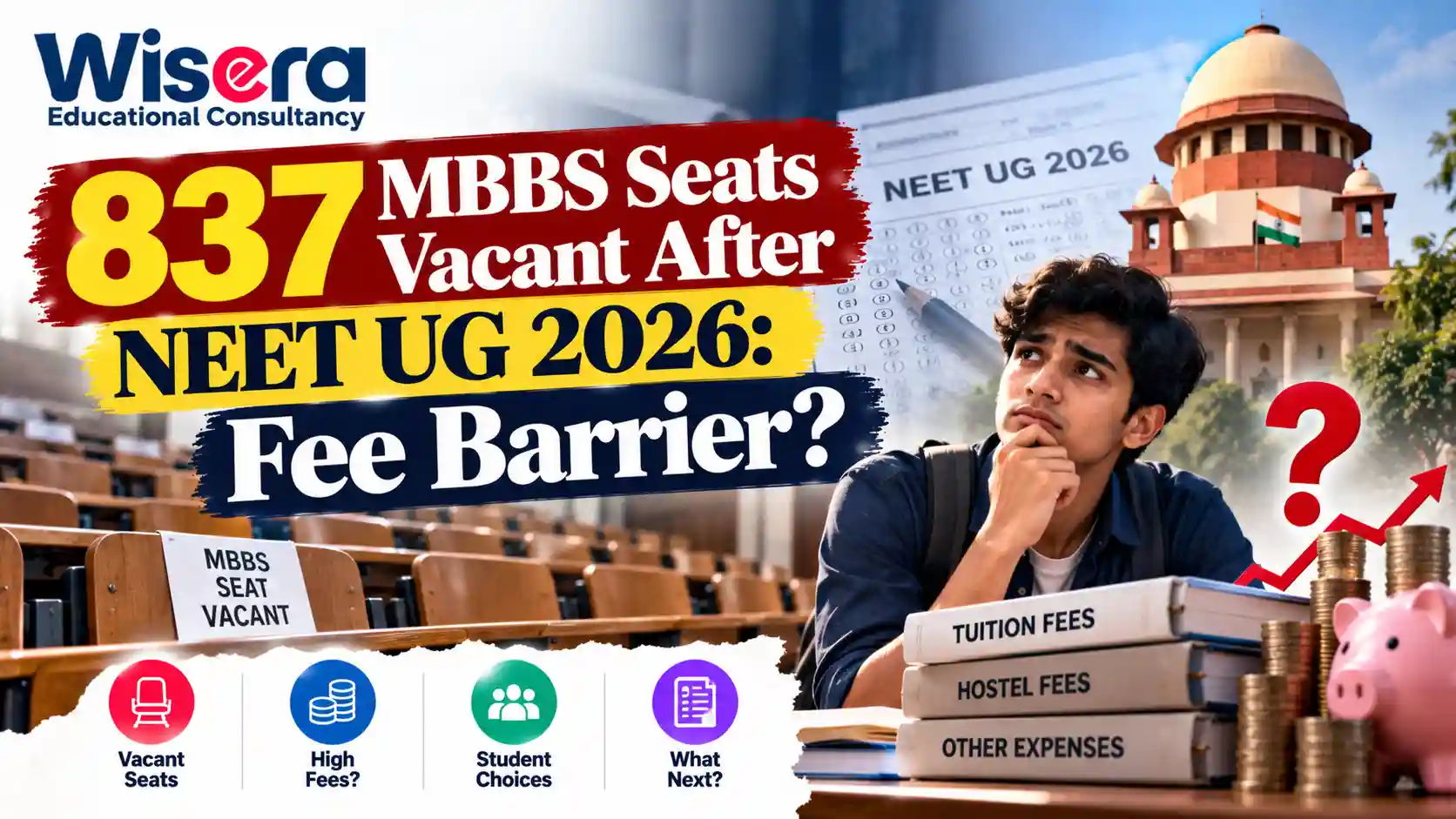





837 MBBS Seats Vacant After NEET UG 2026: Fee Barrier?
The news that 837 MBBS seats vacant after NEET UG 2026 counselling rounds have gone unfilled has sparked serious conversation among medical aspirants, parents, and education consultants across India. According to a report, Shri Sathya Sai Medical College and Research Institute in Chennai alone reported 188 vacant MBBS seats. This has reignited a long-standing debate about whether India’s deemed universities and private medical colleges are pricing out qualified students despite the country producing one of the largest pools of NEET-qualified candidates every year.
While thousands of students clear NEET UG each year with ranks good enough for admission, a growing number are unable to secure seats simply because they cannot afford the fees charged by private and deemed medical institutions. This gap between eligibility and affordability is now manifesting as empty seats in colleges that otherwise have no shortage of applicants.
WISERA COUNSELLING DESK
Not sure which university matches your NEET score?
Get a free comparison call on NMC-approved options within your budget.
Why Are MBBS Seats Going Vacant Despite High Demand?
India’s medical education landscape is unique: demand for MBBS seats vastly outstrips supply, yet seats remain unfilled every counselling cycle. The primary reasons include:
- Exorbitant fee structures at private and deemed universities, often ranging from ₹20 lakh to over ₹1 crore for the full course.
- Limited availability of education loans or scholarships for middle-class families who don’t qualify for subsidies but can’t afford full fees either.
- Preference for government colleges, where seats are limited and competition is fierce, leaving many qualified candidates without an affordable option.
- Geographic and institutional reputation concerns, where students hesitate to join lesser-known deemed universities despite having a qualifying rank.
- Rising awareness of international alternatives, where the overall cost of a medical degree, including living expenses, can be significantly lower than private Indian institutions.
The situation at Shri Sathya Sai Medical College and Research Institute is not isolated. Multiple deemed universities across states have reported similar vacancies, indicating a systemic issue rather than a one-off anomaly.
The Fee Barrier: A Growing Concern
For many NEET-qualified students, the financial burden of private medical education is simply unsustainable. Even families with moderate incomes find themselves unable to bridge the gap between what government colleges offer and what private institutions demand.
This fee barrier has pushed a growing number of students to look beyond India’s borders. Countries offering MBBS programs recognized by the National Medical Commission (NMC) have become attractive due to significantly lower tuition fees, modern infrastructure, and English-medium instruction.
MBBS Abroad: An Increasingly Popular Alternative
As domestic seats remain vacant due to cost concerns, more students are turning to MBBS abroad programs in countries like Russia, Georgia, Kazakhstan, Philippines, and other NMC-approved destinations. These programs often come with:
- Lower overall tuition costs compared to private Indian deemed universities
- No donation or capitation fees
- Globally recognized curricula with clinical exposure
- Simplified admission processes based on NEET eligibility rather than high-cost management quotas
Students and parents researching these options often consult platforms like wisera.in to compare universities, understand admission requirements, and evaluate the long-term value of studying medicine overseas versus paying premium fees domestically.
What This Means for NEET UG Aspirants
The vacancy of 837 MBBS seats signals a structural mismatch between seat pricing and student affordability. For aspirants navigating this year’s counselling process, it’s worth considering a few strategic points:
- Thoroughly research the total cost of attendance, including hidden fees, before committing to a deemed university seat.
- Explore state quota and government college options extensively before considering private institutions.
- Evaluate MBBS abroad programs with proper NMC approval and screening test eligibility.
- Factor in return-on-investment, including licensing exams required to practice in India after an international degree.
- Consult verified education counselors rather than relying solely on agents who may have financial incentives tied to specific colleges.
This pattern of unfilled seats may also prompt regulatory bodies to reconsider fee caps or introduce more transparent fee regulation mechanisms for deemed universities, especially as public scrutiny around this issue intensifies.
Looking Ahead
The 837 vacant seats are more than just an administrative statistic — they represent a widening gap between aspiration and accessibility in India’s medical education system. As fee transparency and affordability become central themes in the NEET counselling conversation, students are increasingly weighing domestic private options against international alternatives that offer better value for money.
Whether this trend will push policymakers toward fee regulation reforms or continue nudging students toward MBBS abroad programs remains to be seen. For now, aspirants are advised to make informed, well-researched decisions rather than rushing into high-cost seats simply to avoid losing a counselling round.
Frequently Asked Questions
Why are so many MBBS seats vacant after NEET UG 2026 counselling?
High fees at private and deemed universities, combined with limited financial aid options, are the primary reasons many qualified students are unable to accept allotted seats.
Which college reported the highest number of vacant seats?
Shri Sathya Sai Medical College and Research Institute in Chennai reported 188 vacant MBBS seats, among the highest in this counselling cycle.
Is MBBS abroad a good alternative to expensive private colleges in India?
Yes, for many students, NMC-approved MBBS programs abroad offer significantly lower tuition fees and no capitation charges, making them a cost-effective alternative.
Will these vacant seats be filled in later counselling rounds?
Some seats may be filled in subsequent mop-up rounds, but historically, a portion of high-fee seats at deemed universities remain vacant even after all rounds conclude.
What should students consider before accepting a private MBBS seat?
Students should evaluate total costs, loan availability, institutional reputation, and compare it against government college options and international alternatives before finalizing their decision.
Comments are closed