

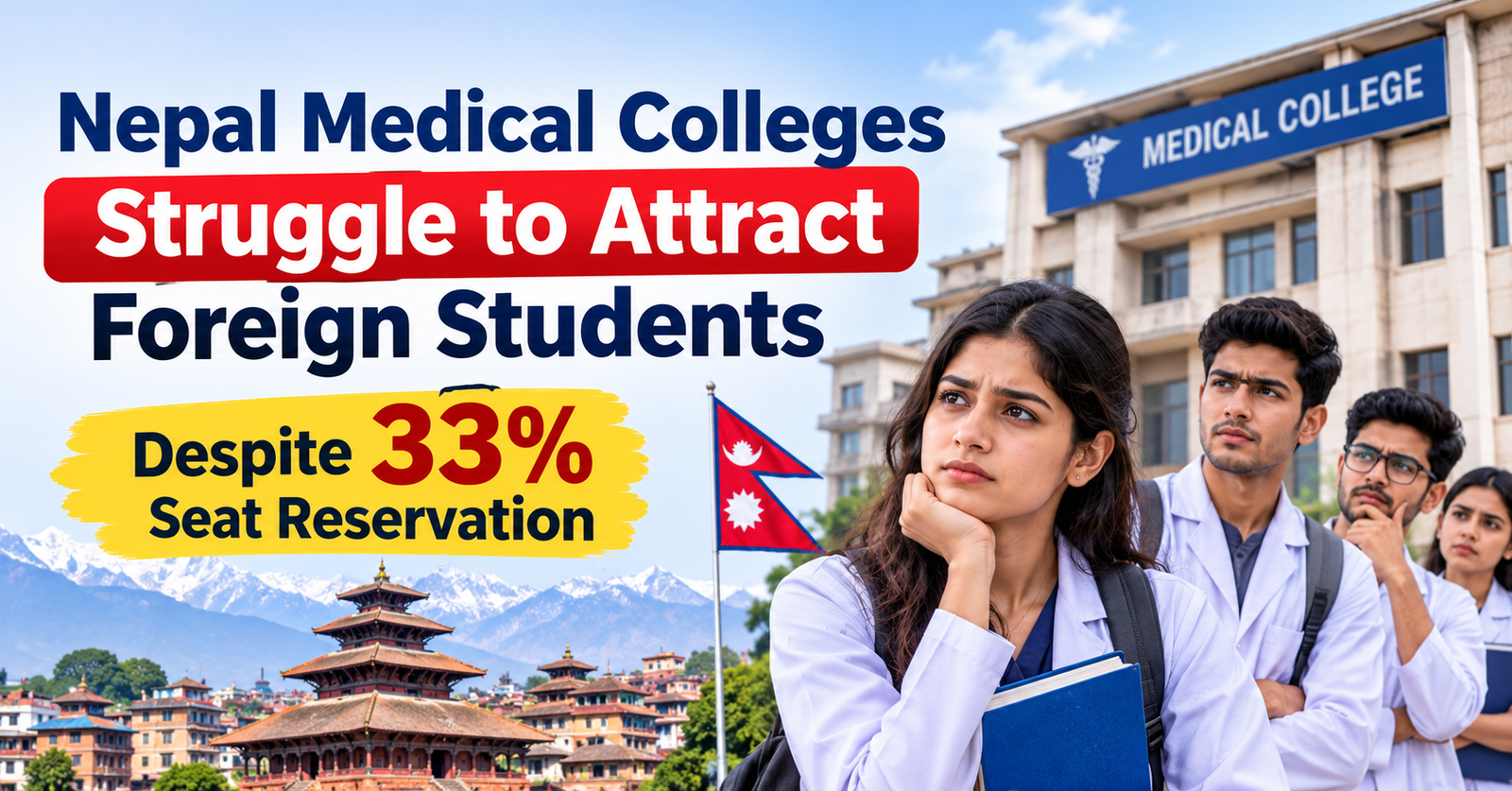
Nepal Medical Colleges Struggle to Attract Foreign Students
Nepal Medical Colleges Struggle to Attract Foreign Students Despite 33% Seat Reservation
Nepal has been struggling to attract international students to its medical colleges, despite reserving 33% of medical education seats for foreign applicants. In the 2026 academic session, only 746 foreign students enrolled in Nepali medical institutions, leaving a significant number of reserved seats vacant.
The trend highlights the growing gap between available medical education opportunities and international student demand, raising questions about Nepal’s position as a preferred destination for students seeking MBBS and other medical degrees abroad.
WISERA COUNSELLING DESK
Not sure which university matches your NEET score?
Get a free comparison call on NMC-approved options within your budget.
Only 176 Foreign Students to Appear for Nepal’s Medical Entrance Examination
A total of 176 international students are expected to appear for Nepal’s Integrated Entrance Examination for Medical Education this year. Applicants from India, Bangladesh, the Maldives, and other countries will participate in the examination.
According to the Medical Education Commission (MEC), 77,359 students have applied for the 2027 academic session, competing for 9,691 seats across 16 medical education programmes. Last year, 146 foreign students appeared for Nepal’s common medical entrance examination.
Although the number of international applicants has increased, foreign student participation remains relatively low compared with the number of seats reserved for them.
Why Are Foreign Students Not Choosing Nepal for Medical Education?
Under Nepal’s Medical Education Act, 33% of medical college seats are reserved for international students. However, the actual enrolment figures reveal that the country is yet to attract enough foreign applicants to utilise this quota.
For the 2026 academic session, 2,428 out of 9,273 medical education seats were allocated to foreign students. However, only 746 students enrolled, filling approximately 30% of the reserved capacity and leaving 1,682 seats vacant.
These unfilled seats were subsequently transferred to the paying category for Nepali students, allowing domestic applicants to secure additional admission opportunities.
The figures suggest that although Nepal offers considerable opportunities for international medical students, attracting foreign applicants remains a major challenge for its medical education institutions.
MBBS in Nepal: The Most Preferred Course Among Foreign Students
MBBS continues to dominate international student enrolment in Nepal. Foreign applicants show a strong preference for the Bachelor of Medicine and Bachelor of Surgery programme, while interest in other medical and healthcare courses remains limited.
Of the 746 foreign students admitted during the 2026 academic session, 742 enrolled in MBBS programmes. In comparison, international admissions in nursing, pharmacy, and most other medical disciplines were negligible or non-existent.
This concentration of demand in MBBS highlights a mismatch between the range of programmes offered by Nepali medical colleges and the courses international students actually want to pursue.
Although Nepal provides 16 medical education programmes, MBBS remains the primary attraction for foreign applicants.
How Can Indian Students Study MBBS in Nepal?
Indian students represent approximately 90% of foreign applicants seeking admission to medical colleges in Nepal, making India the largest international student market for Nepal’s medical education sector.
Foreign students can secure admission through two routes:
- Nepal’s Common Entrance Examination: Students can qualify through the medical entrance examination conducted by the Medical Education Commission.
- India’s NEET Examination: Nepal also recognises India’s National Eligibility cum Entrance Test (NEET) for medical college admission.
According to Arjun Dhakal, information officer at the Medical Education Commission, more Indian students historically seek admission to Nepali medical colleges after qualifying through NEET than those who travel to Nepal to sit its common entrance examination.
This means the number of foreign candidates appearing for Nepal’s entrance examination does not represent the total number of international students seeking admission.
For Indian students exploring MBBS abroad, Nepal remains an available medical education destination, with NEET providing an additional admission pathway.
Nepali Students Continue to Prefer MBBS and BDS
While foreign students largely focus on MBBS, Nepali applicants also show strong demand for MBBS and Bachelor of Dental Surgery (BDS) programmes.
Competition for these courses remains intense, particularly among students applying through the domestic paying category. Meanwhile, several other medical education programmes continue to have vacant seats despite being available for admission.
For the 2026 academic session, Nepal recorded an overall enrolment of 8,550 students out of 9,273 allocated seats, representing approximately 92% of total capacity.
Interestingly, the domestic paying category exceeded its initial allocation. Although 3,970 seats were originally designated for Nepali paying students, 5,114 students eventually secured admission after vacant foreign-quota seats were transferred.
Scholarship enrolment was also relatively high, with 2,609 students filling 2,771 allocated scholarship seats, representing approximately 94% of the available capacity.
According to commission officials, some scholarship seats remained vacant because eligible candidates were unavailable in certain inclusion categories.
More Nepali Students Are Choosing Medical Education Abroad
One of the most significant developments in Nepal’s medical education sector is the increasing number of Nepali students seeking medical degrees overseas.
According to the Medical Education Commission, 4,741 Nepali students received permission to pursue medical education abroad across different academic levels over the past three years. During the same period, only 1,859 students enrolled in medical education programmes within Nepal.
India emerged as the leading destination, with 1,677 Nepali students receiving permission to study there, accounting for nearly half of the total.
Around 1,350 students specifically chose to pursue MBBS and nursing programmes abroad.
These figures reveal an interesting contrast: Nepal continues to struggle to attract international medical students, while many of its own students are exploring medical education opportunities in other countries.
For education platforms such as Wisera, these changing trends highlight the importance of keeping students informed about international medical admissions, MBBS opportunities, entrance examinations, and study-abroad destinations.
Nepal Increases Medical College Seats to Expand Education Opportunities
To strengthen access to medical education, the Medical Education Commission has increased the number of seats in government medical colleges by 418 compared with the previous year.
The expansion is expected to create more opportunities across different admission categories, including free seats, scholarship seats, and those reserved for foreign students.
However, increasing the number of medical college seats may not be enough to address Nepal’s international enrolment challenges. Attracting foreign applicants, improving awareness of available programmes, and understanding international student preferences will remain important for the country’s medical education sector.
Final Thoughts: Can Nepal Become a Preferred Destination for International Medical Students?
Nepal has the infrastructure, academic programmes, and reserved admission capacity to attract international students interested in pursuing medical education. However, the latest enrolment figures show that the country has yet to fully utilise this potential.
With only 746 foreign students enrolling against 2,428 reserved seats in the 2026 academic session, attracting international applicants remains a key challenge.
The strong preference for MBBS, limited demand for other medical disciplines, and growing number of Nepali students pursuing medical education abroad highlight the need for a more focused approach to international student recruitment.
As Nepal continues to expand its medical education capacity, improving global visibility and strengthening international student outreach could help its medical colleges attract a larger share of foreign applicants.
For students considering MBBS in Nepal or exploring medical education abroad, Wisera aims to keep them informed about relevant admission developments, international education opportunities, and changing study-abroad trends.
Frequently Asked Questions (FAQs)
1. Why are Nepal's medical colleges struggling to attract foreign students?
Low international demand has left many reserved seats vacant, highlighting why Nepal Medical Colleges Struggle to Attract Foreign Students.
2. How many foreign students enrolled in Nepal in 2026?
A total of 746 foreign students enrolled, reflecting the trend of Nepal Medical Colleges Struggle to Attract Foreign Students.
3. What percentage of medical seats are reserved for foreign students in Nepal?
Around 33% of medical education seats are reserved for international students, but Nepal Medical Colleges Struggle to Attract Foreign Students despite this quota.
4. Which course is most popular among foreign students in Nepal?
MBBS is the most preferred course, with 742 foreign students enrolling in 2026, even as Nepal Medical Colleges Struggle to Attract Foreign Students.
5. Can Indian students study MBBS in Nepal through NEET?
Yes. Nepal recognises NEET as an admission pathway for Indian students, although Nepal Medical Colleges Struggle to Attract Foreign Students overall.




Comments are closed