




Affordable MBBS Abroad: How to Plan Your Medical Education Budget Across Six Years
Affordable MBBS abroad is not the course with the lowest tuition line. It is the one your family can fund from the first semester to the last internship month. Many families compare first-year fees, then find that the real bill runs across several years and several currencies. This guide shows how to plan across the whole course, using NMC rules, the tax rules in force from April 2026, and the latest FMGE updates.
What Does Affordable MBBS Abroad Really Mean?
Affordable means your family can pay every instalment on time for the full course, not just accept a low first-year quote. A university with lower tuition can still cost more overall once housing, insurance, travel, and exam costs are added. Compare options by the total cost of MBBS abroad for Indian students across the whole pathway. Then confirm that the specific university and programme meet NMC requirements. A cheaper course that fails that check is not affordable at any price. Wisera’s complete MBBS abroad guide explains the compliance side in detail.
How Many Years Should You Budget For?
Plan for at least 66 months abroad. NMC’s FMGL FAQ sets a minimum 54-month course plus a 12-month internship in the same foreign institution. A further 12-month supervised internship in India follows. Most families therefore plan around six annual payment cycles abroad. The same-institution rule matters for money too, because the course, training, and internship must all happen at one institution. Treat your first choice as your only choice, and price it that way. FMGE preparation and the India internship come after graduation.
Which MBBS Abroad Costs Repeat Every Year, and Which Hit Once?
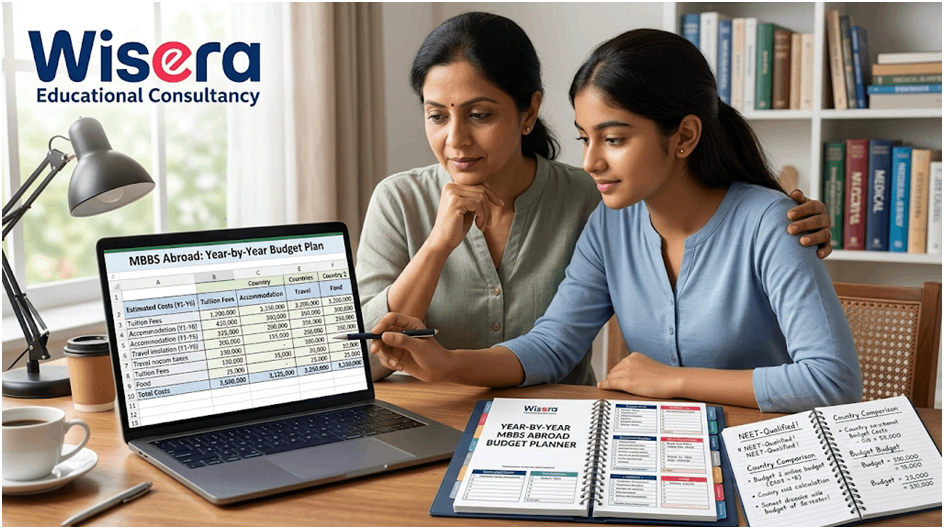
Recurring costs return each year: tuition, housing, food, local transport, insurance, and trips home. One-time costs cluster at admission, such as registration, visa, first flights, and settling in. Splitting costs this way stops a heavy first year from skewing your yearly average. Use the table to sort each line before comparing universities.
| Cost | Pattern | How to plan it |
| Tuition | Every year | Get the year-wise schedule in writing |
| Hostel or rent | Every year | Check if included or billed separately |
| Food and daily living | Monthly | Budget monthly, then multiply by 12 |
| Insurance | Usually yearly | Confirm what the policy covers |
| Visa and permits | At entry, then renewals | Note renewal dates early |
| Flights home | Once or twice yearly | Book early, add a buffer |
| FMGE and India internship | After graduation | Budget exam and living costs |
What Are the Hidden Costs of Studying MBBS Abroad?
Hidden costs are the ones missing from the brochure but present in the bank statement. They rarely look large alone, yet together they can strain a six-year plan. Watch for these:
- Exchange-rate movement between the rupee and the fee currency
- Bank charges and TCS on remittances (see below)
- Fee revisions between years, if the agreement allows them
- Residence permit and insurance renewals
- Unplanned flights home during holidays or emergencies
- FMGE preparation, exam fees, and living costs while preparing
- A year of living costs during the India internship
How Do You Divide the Budget Across Six Years?
Think in phases, not averages. Year 1 is the heaviest outflow: admission, deposits, visa, flights, and settling in. Years 2 to 4 are usually steady tuition and living costs, but ask whether clinical postings change housing or transport costs. Years 5 and 6 cover the final course months and the foreign internship, so ask whether internship months carry separate fees. After graduation, plan for FMGE preparation and the 12-month India internship. Revisit this split every year, since fees and exchange rates move.
How Do Exchange Rates, TCS, and Payment Schedules Affect the Plan?
From 1 April 2026, self-funded education remittances carry no TCS up to ₹10 lakh per financial year, then 2% above that. Education remittances funded by a loan from a specified financial institution carry nil, as per a Standard Chartered notice on the amended rules. For example, a ₹15 lakh remittance in one year means TCS on the ₹5 lakh above the threshold. Ask your bank and a chartered accountant how the threshold applies to your PAN. Also ask which currency the fees are quoted in, and keep a reserve for rate movement. Pay only through the official details on your offer letter. Wisera’s guide on what to verify before paying admission fees explains why.
How Big Should Your Emergency Fund Be?
Size it by events, not percentages: one unplanned flight home, one extra semester of living costs, and one exam retake window. Exam timelines are shifting. After protests over the June 2026 session, NBEMS announced an additional FMGE by the end of October 2026, a lower fee from the next sitting, and reportedly three sittings a year from 2027. Keep your reserve flexible so timing changes do not become a crisis. Wisera’s FMGE or NExT page tracks updates.
WISERA COUNSELLING DESK
Not sure which university matches your NEET score?
Get a free comparison call on NMC-approved options within your budget.
What Should You Ask Before Paying the First Instalment?
Ask for everything in writing before the first payment. Written terms protect both sides and make universities and consultancies easy to compare:
- A year-wise fee schedule, with what each fee includes
- Whether fees can be revised during the course
- The refund policy if admission or the visa is not granted
- Whether hostel and food are included or separate
- Official payment details shown on the offer letter
- How the university and programme meet NMC’s FMGL requirements
- Any consultancy fee, stated in writing
Wisera says it explains fees, admission steps, and university details upfront, so hold every consultancy, Wisera included, to a written breakdown. Read why choosing the right consultancy matters, then compare shortlisted countries in the best country for MBBS guide.
FAQs
How much should I budget for MBBS abroad?
No single figure fits every case. Get a year-wise fee schedule, add living, travel, insurance, visa, and exam costs, then add a buffer. Wisera’s free counselling can help compare options within your budget.
How many years does MBBS abroad take?
NMC’s FMGL framework sets a minimum 54-month course plus a 12-month internship in the same foreign institution. A 12-month supervised internship in India follows.
Is a cheaper university always more affordable?
No. Total cost includes housing, travel, insurance, and exams. Compliance with NMC requirements matters as much as price.
Is there TCS on MBBS fees sent abroad?
For self-funded remittances, there is nil TCS up to ₹10 lakh per financial year and 2% above, from 1 April 2026. Loan-funded remittances from specified institutions carry nil. Confirm with your bank.
Can I switch universities if costs rise?
NMC’s FAQ says the course, training, and internship must be done in the same foreign institution. Check with a counsellor before any move.
Ready to Plan Your Six-Year MBBS Abroad Budget?
Book free counselling with Wisera’s team at wisera.in or call +91 98887 98897 (Mon–Fri, 9:30 AM–8:30 PM). Bring your NEET score and budget range, and ask for a year-wise cost breakdown on your shortlisted MBBS destinations.
Comments are closed